“The Regenerative and the Reductive Options for Full-Arch Implant Cases.” (Article #48)
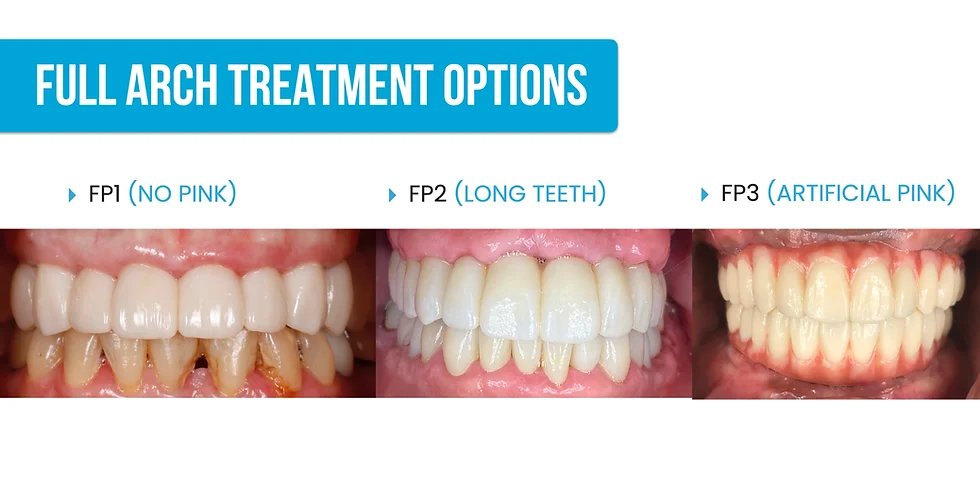
When someone is in the market to wanting dental implants and they are needing multiple implant placements to replace several natural teeth on a greater scale, then there are commonly two choices that is available to them. The choices include whether to extract (if needed) only the unsalvable teeth followed by preserving the remaining bone and gums or to extract all the teeth followed by grinding down or removing the bone without any preservations in mind. In the very end, after either of these procedures are performed, dental implants will eventually be placed and fitted for an implant prosthesis. For that reason and for the rest of this article, the above-mentioned choices will be termed the “regenerative option” and the “reduction option”, respectively.
When it comes to dental implants, every case is a unique situation and therefore may necessitate a different type of treatment plan from one person to the next. The lesser the number of teeth that will be needed to be replaced with dental implants then the more likely a person is better off since the more simplified the treatment options will become. Hence, if a person is quite healthy and takes care of his or her teeth but somehow loses only one tooth in his or her mouth, then there is a good chance that the overall solution would be the need of a single dental implant along with an implant crown as the final restoration. This is the quite the “simple fix” within the world of implant dentistry. But on the other hand, if a person suffers from poor oral health, he or she may have numerous teeth that are unsalvageable and will need to be extracted or removed or that may already have many missing teeth to begin with. In these cases, the treatment plan may not be the “simple fix” as mentioned above and may instead be labeled as being complicated as one have not imagined initially. Moreover, it will require many additional procedures than what a person had hoped for to getting his or her teeth back into the most optimal functional and esthetic state.
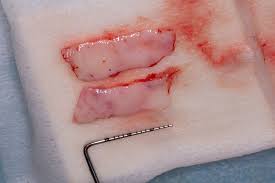
Today’s article is in reference to the more complicated cases and is not pertaining to the “simple fix” cases. When it comes to the complicated cases, how does one consider what is complicated and what is not? For example, one person may have lost only one tooth in an accident in addition to the loss of abundant bone and therefore will now not only need a dental implant but also a bone graft and even with a soft tissue graft alongside with it. As a result, this could be deemed complicated but truthfully, I am not speaking of these types of exceptional cases. I am keeping this simple, and I will be referring to the complicated cases in this article as cases that pertain to individuals with a full arch with eight teeth or less and with moderate to advanced periodontal disease (moderate to advanced bone loss).
Individuals that fall into this classification and that are choosing dental implants with a prosthesis as the treatment solution are typically advised and presented with two main options given all things being equal or similar. The first option is the regenerative option. This option not only concentrates on preserving what is already present at hand but aims to reconstruct any hard and soft tissue (bone and gums) that is insufficient or missing. The second option is the reduction option. This option, as you might have already guessed, is just the opposite. Instead of focusing on preserving or keeping what you already have, this option comprises of removing hard and soft tissue but primarily centers on removing bone only. Currently, both options are viable options available today and there’s not one that is better than the other; both options have their advantages and disadvantages as I will explain.
The regenerative option is the most conservative option among the two but not without a cost. And by cost, I mean that this could potentially cost an individual a lot more money than the other option since you are fundamentally attempting to reestablish bone volume and gums to a former or ideal state. And if an individual is missing portions on a larger scale, then this would result in requiring a greater number of procedures needed. Not only that, not just the greater number of procedures will be needed but the potential of complicated procedures will increase as well. As you can see, for many people, they may already have lost their interest since they find just the number of needed procedures alone staggering and unsettling. And to make matters worse, the procedures themselves do not come without a cost and could potentially begin to add up significantly and be quite expensive. The other factor that could turn people away from this option pertains to the additional procedures that are required and that may not be what many people may want to endure or tolerate. For example, it’s already hard enough for many people to even want to go to the dental office for a simple but necessary tooth filling out of total fear but now to needing and getting multiple surgical procedures is extremely terrifying on a whole new level to most people – trust me, I get it. But the benefit for choosing the regenerative option is that you are retaining whatever you already have and to building on top of that. Thus, there will not be any bone removal involved which could be an issue for some people since they realize once they lose it, they know how difficult it is (or almost impossible) to getting it all back.
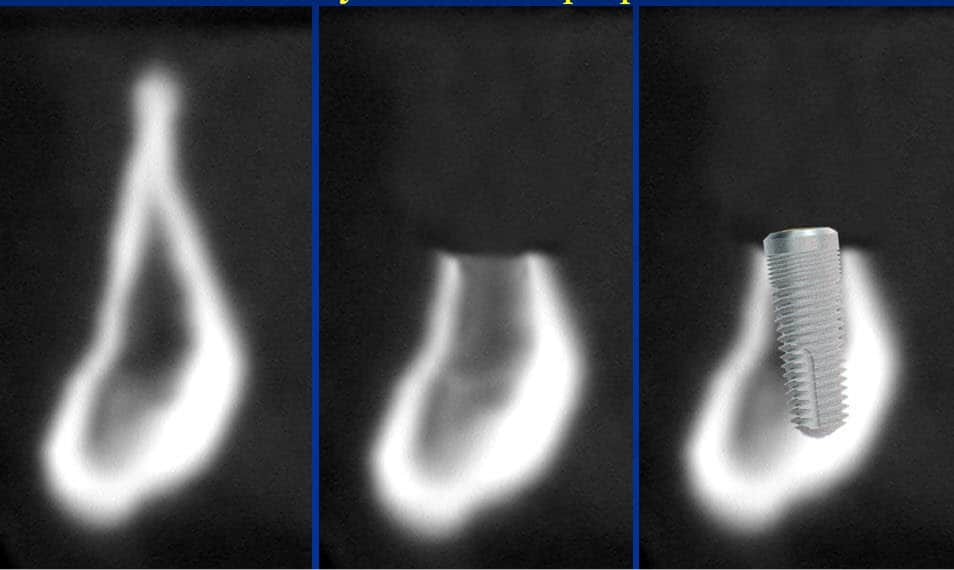
For the reduction option, the hard tissue (bone) is removed by grinding or shaving it away. Many individuals will ask why the bone removal is necessary for this option so I would like to explain it. The bone is removed to serve four main reasons. The first, is to create the space that would be required for the parts of the full-arch implant prosthesis. The second, is to hide the transition line (the border of the prosthesis and the natural gums) when the person smiles. The third, is to flatten and to level the bone. And the fourth, is to create a wide enough floor bed so that there is an adequate amount of bone that surrounds the implants which promotes the overall success. With the reduction option, there is only one main surgical procedure, and it avoids having multiple procedures which could include bone harvesting, soft tissue harvesting, or sinus lifts which keeps the overall costs down. In addition, the time involved from the very beginning to getting the final prosthesis is generally a lot quicker. For these reasons, the reduction option is widely popular among people wanting a full-arch implant prosthesis.
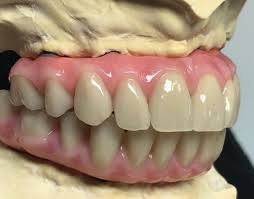
In conclusion, both options are great and making the correct decision soley depends on an individual’s own preference since there are many aspects that come into play to help determine it. When done correctly, the overall results for either option has proven to be outstanding and highly recommended by dentists compared to getting traditional complete dentures. If the regenerative option is chosen, the quality of the results would be greatly determined by the experience of the provider. If done correctly, the results would be very natural since the patient’s own gums will be normally combined with the implant prosthetic teeth as seen when the person smiles. But with the reduction option, you will see only the prosthesis itself which will now also include the prosthetic gums and if done right, it could appear just as good and natural if not better. In short, it all comes down to what the individual’s needs and expectations are.
Author:
Dr. Charles Chow